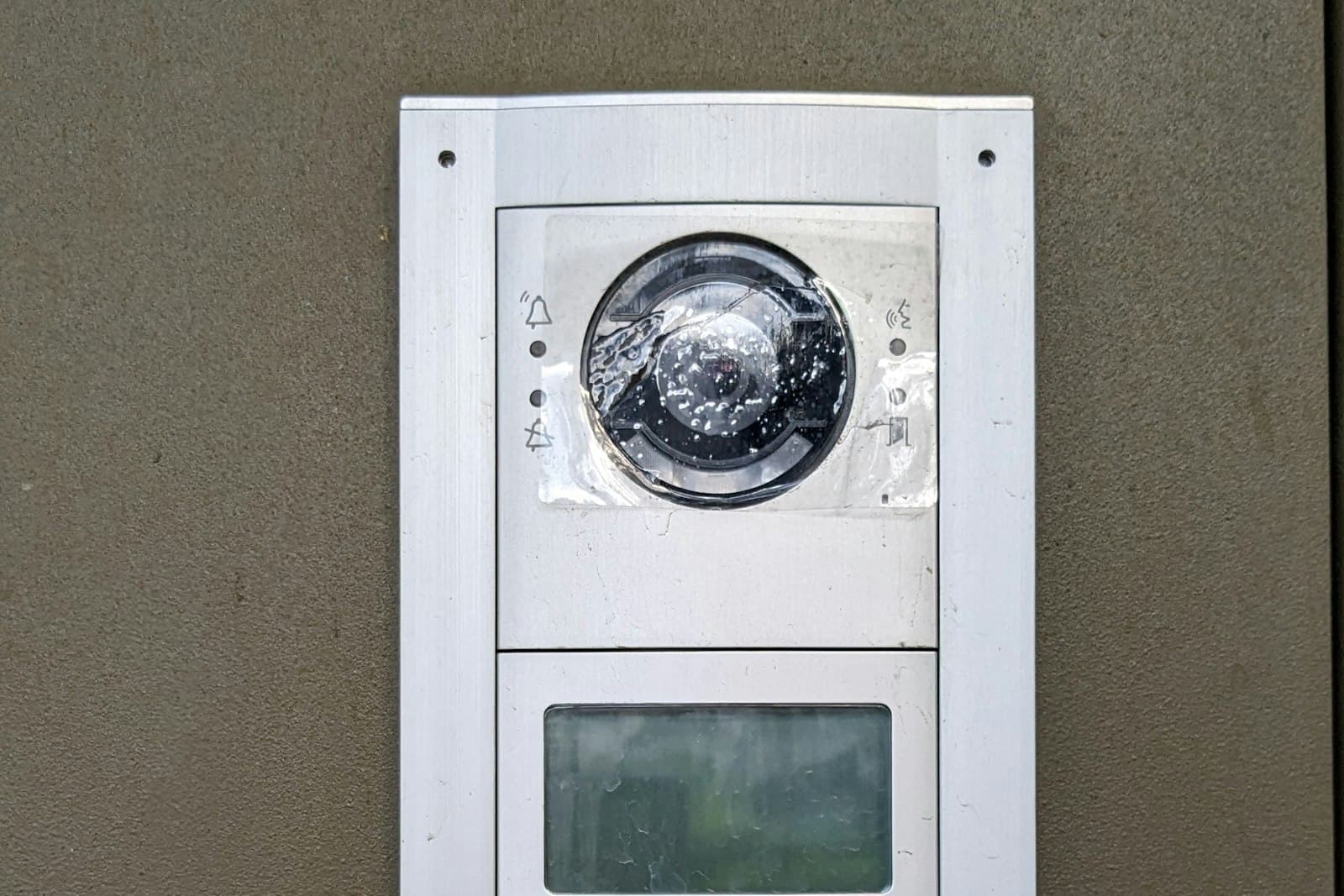
What a video intercom does, and how it differs from a video doorbell
A video intercom, also called a video door entry system, has three parts. An outdoor station at the gate or door carries a camera, a microphone, a speaker and a call button. An indoor monitor shows the visitor and lets you talk to them, and many homes have more than one, in the majlis, the kitchen or upstairs. The third part is the door release: a button on the monitor that sends a signal to an electric lock or a gate motor. An audio intercom does the same without the camera; many older buildings still have handsets that ring but show nothing.
A video doorbell looks similar but works differently. It connects over Wi-Fi and rings an app on your phone rather than a screen in the house. It often runs on a battery, and many models keep their recordings in the cloud for a subscription. It suits a flat, or a house with one door and good Wi-Fi at the entrance. A villa with a distant gate, several screens and a lock or gate motor to open is a job for an intercom. It runs on its own cable and keeps working when the Wi-Fi or the internet stops.
Villa, building or office: what each one needs
In a villa, the outdoor station usually stands at the pedestrian gate, sometimes with a second at the front door. It can open that gate and, through its motor, the vehicle gate. In many villas the gate is far from the house, so the cable runs underground in a conduit, and that route decides much of the work. Many families want a monitor on every floor and an answer on their phones when they are out. If the villa has a smart home system, the intercom can join it when the two are compatible, so the gate opens from the same app that controls the lights.
Installing an intercom in an apartment building calls for a different design. An entry panel in the lobby carries a button for each flat or a keypad, every flat has its own monitor, and residents open the building door from it. Larger systems add a station for the guard, which takes calls when a resident does not answer. Residents can also open the door with a card or a code at the same panel. In an office, the station at the entrance rings reception, or a phone when reception is empty. Staff open the door with their cards or faces, and only visitors press the call button.
2-wire or IP: which intercom system to choose
A 2-wire intercom carries power, sound, video and the door release over a single pair of wires. Its strength is reuse: it can usually run on the wires an old intercom left in the walls. That matters in a finished villa or an occupied building, where opening walls costs a lot. Its limits are the number of monitors it supports, the distance it reaches and the picture quality. Answering from a phone takes a Wi-Fi monitor or an extra device called a gateway.
An IP intercom runs on network cable from a PoE switch that powers each unit, the way IP cameras are powered. It gives a sharper picture and room for far more monitors and entrances. Many models answer on phones without a gateway, and some record to your camera recorder when the two are compatible. Where cable can be laid, in a new villa or an office fitted out from the start, IP is usually the better choice. Where intercom wiring is already in place in an existing building, 2-wire is usually the sensible one.
Wireless intercoms suit a place no cable can reach, such as a gate at the far end of a garden that cannot be dug up. The range printed on the box is measured in open air; concrete walls and metal gates shorten it, and an outdoor unit that runs on a battery needs charging. For a villa or an office, a wired system, 2-wire or IP, stays the steadier choice, and the cable already in place decides which one suits you.
- Power, sound and video on two wires
- Can reuse old intercom wiring
- Limited monitors and distance
- Phone calls need a Wi-Fi monitor or a gateway
- Suits existing villas and buildings
- Runs on network cable with PoE
- Sharper picture, room for many screens
- Many models answer on phones
- Needs a secured network
- Suits new villas and new fit-outs
Opening the door: electric locks, gates and access control
The intercom opens nothing by itself. The button on the monitor sends a signal, and an electric lock on the door or the controller of the gate motor does the opening. A pedestrian gate or a front door needs an electric strike or a magnetic lock with its own power supply. A vehicle gate, sliding or swinging, calls for a controller with an input that accepts the intercom's signal. On an escape route, people inside must always be able to leave: a magnetic lock has to release on the fire alarm and on power loss, while an electric strike relies on an inside handle that always opens, as our access control guide explains.
When the intercom shows the visitor but the door stays shut, the cause is usually in that chain, not in the screen. Common causes are a failed power supply for the lock, a loose connection on the release wires, a lock that has shifted out of line with the door frame, or an opening time set too short. The same chain links the intercom to access control. An outdoor station with a card reader, a keypad or face recognition lets residents and staff open the door themselves while visitors call. Each card, code, face and release from the screen is kept in one log.
Answering from your phone, and what works when the internet drops
A smart intercom passes the call to an app on your phone, so you can see the visitor and open the gate from anywhere. That helps with deliveries and guests who arrive while you are out. The call travels over the internet, usually through a cloud service run by the maker. It needs a steady connection at the property and an app the maker still updates. Ask how many phones can take the call, whether the app asks for a subscription, and whether the phones ring together or one after another.
The app is an addition to the system, not a replacement for it. The outdoor station, the monitors and the door release should work inside the property with no internet at all. At handover, ask the installer to show you the system working with the internet line unplugged. An intercom on the network is also a camera at your gate. It belongs on the network kept for smart devices, away from the computers and files, with its default password changed and its firmware kept up to date.
The intercom's outdoor station, the UAE heat and the cable
The outdoor station faces the hardest conditions of any part of a video intercom. In a UAE summer a panel facing the sun gets far hotter than the air around it. Look for an operating temperature range that covers that, a weather rating of IP65 or higher, and a hood that shades the camera. Set the station at about face height, around one and a half metres. Avoid pointing the camera into the low afternoon sun, which turns the visitor into a dark outline. A camera with wide dynamic range (WDR) and night vision copes better with bright sun and with darkness. At a building entrance, a vandal-resistant panel is worth its extra cost.
The cable deserves the same care. Between the gate and a villa it should run in its own conduit, away from power cables, which can cause hum and interference in the sound and the picture. An IP cable stays within 100 metres of its switch. Beyond that the run changes to fibre, which carries no power, so the gate needs its own power and a small fibre switch. In a villa still under construction, settle the positions before the walls close: a cable and a back box at each monitor position, a conduit to each gate, and power at the gate motor. Adding them once the building is finished costs far more.
Repairing an old intercom, or replacing it
Most intercom faults have ordinary causes. The picture disappears or rolls, the sound hums, the monitor stops ringing or the release stops working. Most of these come from water that got into the outdoor station, connections that corroded at the gate, or a power supply at the end of its life. Maintenance fixes these, and a technician who tests the cable and the power supply before changing parts saves you the price of a new set you did not need.
Replacement makes sense when spare parts are no longer available, when the system has sound only and you want a picture, or when residents want to answer from their phones. If the old wiring is sound, a modern 2-wire video system can often use it, so the walls stay closed. In a building, change the whole system at once, or ask whether the new panel can serve the old and new monitors together while the change goes on.
What sets the price of a video intercom
The cost of a video intercom for villas and offices depends more on the building than on the device. The first line is the number of entrances, since each has its own outdoor station. Then come the indoor monitors and their size, and the type of system, 2-wire or IP. The cabling follows, with any trench between the gate and the house, then the locks, the release buttons and the link to the gate motor. In a building, the number of flats on the entry panel counts too. Picture quality, a card reader or face recognition at the door, and answering from phones add to it.
Two points make quotes easier to compare. Check that each one lists the same entrances, monitors and locks, because a lower price can leave the lock or the cable to the gate out of the quote. And ask whether the app or the cloud service carries a yearly charge, because some makers charge one and others do not.
We start with a visit to the property: the entrances, the gates and their motors, the doors and the cable already in place. Then we propose the system and give you one fixed price for that scope before any work begins.
- 01List the entrancesEvery gate and door where visitors arrive, and which ones must open from the screen.
- 02Decide where to answerMonitors in the rooms you use, a guard station, reception or phones.
- 03Check the cable in placeOld intercom wiring a 2-wire system can reuse, or a route for new network cable.
- 04Choose the system2-wire or IP, with a camera that copes with sun and darkness.
- 05Prepare the locks and gatesAn electric lock for each door, and a gate motor that accepts the intercom's signal.
- 06Test before handoverEvery call, every release, and the whole system with the internet off.